Language
  EN
EN RU
RU ES
ES DE
DE EL
EL IT
IT JA
JA KO
KO PT
PT ID
ID SR
SR UK
UK VI
VI TH
TH TR
TR MS
MS BE
BE AR
ARDelphi E3 Common Rail Injector Guide: Volvo D13 Testing & Repair
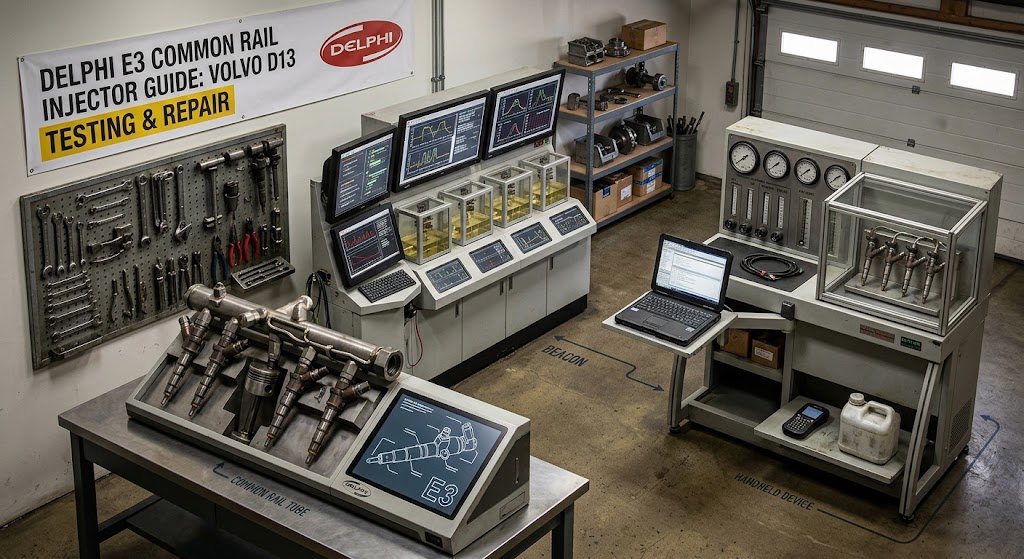
Delphi E3 Common Rail Injector Guide: Volvo D13 Testing & Repair
The Delphi E3 injector is the electronic unit injector behind a huge share of Volvo heavy trucks across Europe, Russia and the Middle East. It appears as the OEM 21569200, 21340611 and 21340616 family on D13, D13C and MD13 engines, and it is one of the most frequently rebuilt injectors in any truck workshop. This guide covers what makes the E3 different, how it fails, and what a workshop needs to test it properly. If you are setting up an E3 repair line, talk to us on WhatsApp and we will help you match the right bench and adapters.
1. What Makes the Delphi E3 Different
The E3 is usually called a common rail injector, and in daily workshop language that is close enough - it runs on a high pressure rail and it is electronically controlled. Technically it is an electronic unit injector (EUI) with an additional valve inside the injector body, positioned just before the nozzle. That extra valve is the heart of the Delphi double pulse control system, and it is why the E3 cannot be treated as a generic solenoid injector.
On a conventional solenoid common rail injector a single control valve opens and closes the needle. On the E3 the module control unit sends an additional electronic pulse that opens a second spill control valve before the main injection event. This gives independent control over how fuel is metered and how it is injected, which is how the E3 achieves pilot injection, rate shaping and quieter combustion on a heavy duty engine.
That extra stage means three things for a workshop:
The injector has two electrically driven stages, so an electrical fault can sit in either one.
Testing needs a driver that can reproduce the double pulse waveform, not just a single open/close command.
The mechanical section has more sliding surfaces, so wear shows up in more places.
2. Applications and Injector Identification
The E3 family is concentrated on Volvo heavy truck engines plus a few related industrial applications. These are the numbers that come up most often in workshop enquiries.
| Engine | OEM number | Delphi / BEBE reference |
|---|---|---|
| Volvo D13 / D13C | 21569200, 7421569200 | BEBE4K01001 |
| Volvo D13 (low power) | 21340611, VOE21340611 | BEBE4D24001 |
| Volvo FH13 / FM13 | 21340612, 21340616 | BEBE4D series |
| Volvo MD13 industrial | 21569200 | BEBE4K01001 |
Identification matters because E3 calibration data is tied to the part number. Two injectors that look identical on the outside can carry different flow characteristics, so always read the number off the body before looking up test data.
3. Common Delphi E3 Failures
Spill control valve contamination
The additional valve stage sits in the fuel path just before the nozzle, which makes it the first component to suffer when fuel quality drops. Water, dirt and microbial contamination from poorly stored diesel collect on the valve seat and change opening behaviour. The engine loses clean pilot injection first, which shows up as a rough idle and louder combustion before anything more serious appears.
Nozzle and plunger wear
High pressure flow erodes the spray holes over time, and the plunger and barrel pair wears in step. Atomisation degrades, combustion becomes incomplete, and the driver sees black smoke, reduced fuel economy and power loss under load. On a heavily used D13 this develops gradually, so it is often only caught when a fault code finally appears.
Internal leakage and electrical faults
Internal leakage is the most expensive failure mode because it affects rail pressure stability and injection timing. A leaking injector delivers too much fuel, producing the hard starting and black smoke that workshops most often associate with a failing E3. Separately, the electrical side can fail at either solenoid stage - a shorted or open actuator stops the injector opening correctly, and the symptom looks identical to a mechanical fault. This is why bench testing with a driver that measures actuator behaviour matters more on the E3 than on a simple injector.
4. Test Bench Setup for Delphi E3 Work
Because the E3 needs double pulse control, the bench driver has to support it. On our common rail benches the Delphi E3 double pulse control system is an optional function, while Delphi, Denso and Siemens coding is included as standard.
| Tier | Bench | Why it fits E3 work |
|---|---|---|
| Flagship | CR919 | Full common rail plus EUI EUP and HEUI coverage, high capacity rail pump |
| High pressure | CR917S | Very high rail pressure for modern heavy duty injectors |
| Comprehensive | CR1029 | Performance testing with full data reporting for a busy rebuild line |
| Mid range | CR1016 | Injector and pump testing at a lower entry cost |
| Compact | CR819 / CR708 | Smaller workshops where Volvo work is one of several lines |
| Piezo and solenoid | CR301 | Where piezo work is also in scope |
Whatever bench you choose, the practical requirement for E3 is the same: double pulse driving, the correct Volvo adapter and clamping set, and a rail that holds a stable reference point while you compare measured flow against stored calibration data. Tell us which numbers you see most on WhatsApp and we will confirm the adapter list before you order.
5. Delphi E3 Test and Repair Workflow
Identify the injector. Read the OEM number and BEBE reference and confirm the engine variant.
Run an electrical check first. Measure solenoid resistance and inductance on both stages, and look for a shorted or open actuator before spending time on hydraulics.
Run the double pulse test plan. Use the E3 control function so the injector sees the waveform it was designed for. A single pulse driver gives readings that do not reflect real operation.
Compare against reference data. Check delivery at the test points and record back leakage. Anything drifting outside the stored range should move to dismantling.
Rebuild and re-test. Nozzle and valve replacement changes flow, so every rebuilt injector must be tested again.
Match the set to the engine. E3 injectors are calibrated as a set, so test the full group and keep records of position and flow.
One practical note: a rough running D13 with black smoke does not automatically mean the injectors need replacing. Boost leaks, EGR faults and rail pressure sensor errors produce very similar symptoms. Confirm the fault on the bench before condemning a set, because a full set of E3 injectors is a significant cost for the customer.
6. Frequently Asked Questions
Can I test Delphi E3 injectors on a standard common rail bench?
Only if the bench driver supports E3 double pulse control. A plain solenoid bench will run the injector, but the readings will not represent the real injection event. Make sure the double pulse function is enabled before you trust the numbers.
Is the Delphi E3 the same as a Bosch common rail injector?
No. Both run on a high pressure rail, but the E3 is a unit injector with an extra internal valve stage and its own calibration data. They need different adapters, test plans and reference data. Do not use Bosch data to judge an E3.
What are the most common E3 failure symptoms?
Rough idle and vibration come first, caused by loss of clean pilot injection. As wear progresses you see hard starting, black smoke, misfire, power loss under load and reduced fuel economy. Internal leakage and actuator faults produce the same symptoms, which is why bench testing is the only reliable way to separate them.
About Beacon Machines
Beacon Machines builds diesel fuel injection test benches for workshops that rebuild common rail, EUI EUP, HEUI and mechanical pump systems. We supply full benches, the Delphi E3 control function, adapters, tooling and remote support to workshops in more than 80 countries. Send us the injector numbers you work with most and we will recommend the configuration that fits your shop. Reach us any time on WhatsApp.
 Beacon Machine Manufacturing Co.,ltd.
 about beacon
PRODUCTS
contact us
TEL: 0086-18253885138
WhatsApp:+86-18253885138
Email: Janechen@beacon-machine.com
Add: High Tech Industry Zone of East Tai an city,Shandong Province,China